 trimoji
 Compatibility between collaborators
Do you want to better understand team dynamics and secure onboarding without losing the human element?
Objective
What is this feature for?
The Trimoji compatibility and affinity feature helps to better understand how collaborators can work together within a team. It provides a structured reading of relational dynamics to facilitate recruitment, onboarding, internal mobility, and organizational adjustments.
Trimoji does not replace the manager, the recruiter, or the human factor. The goal is to provide more readable benchmarks to prepare discussions, anticipate areas of concern, and build concrete collective actions.
Capabilities
What can you do with it?
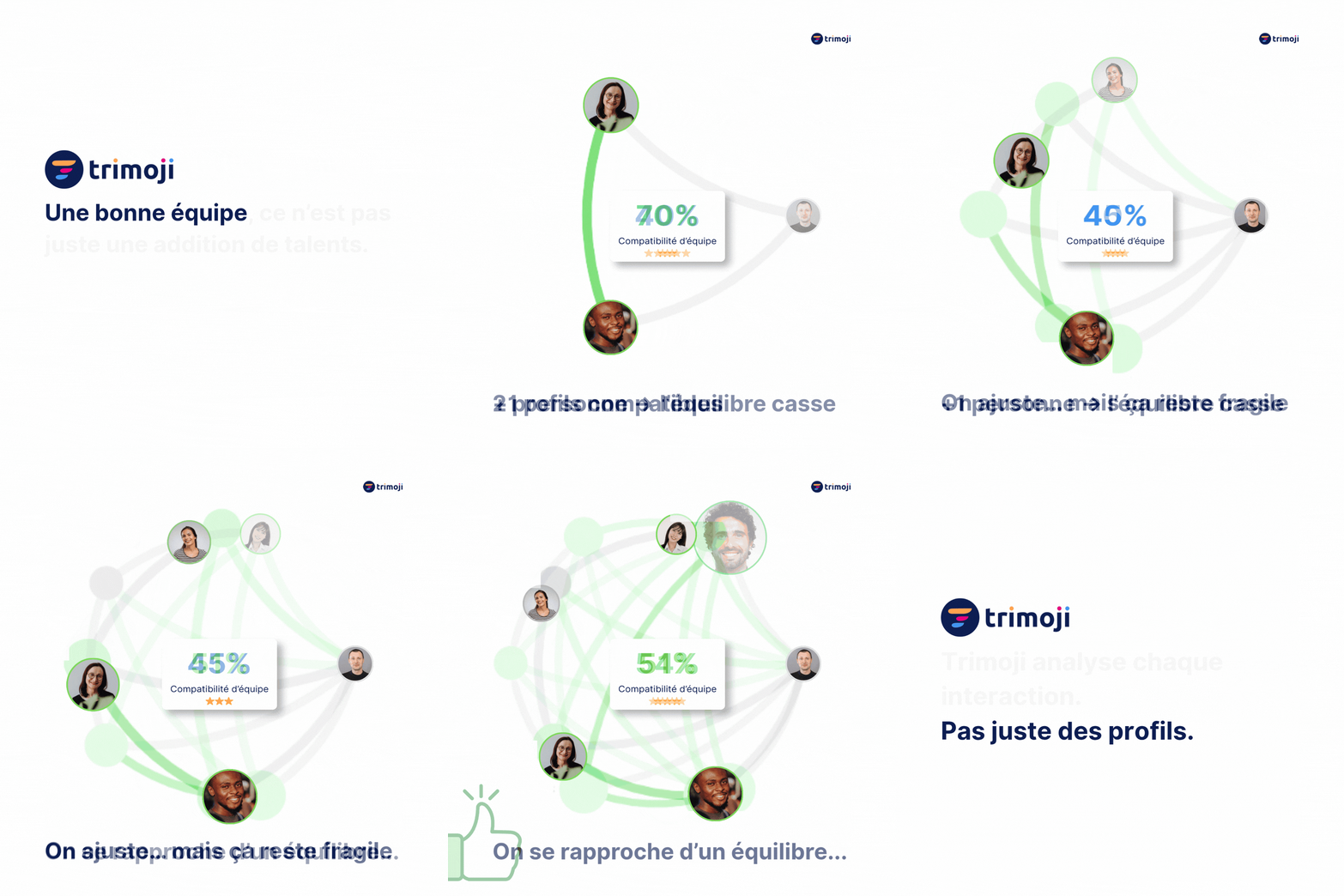
Visualize a team snapshot
Get an overview of the collective to understand the main operating trends, balances, and dominant profiles.
Read team dynamics
Identify complementarities, potential areas of tension, and conditions that promote fluid collaboration.
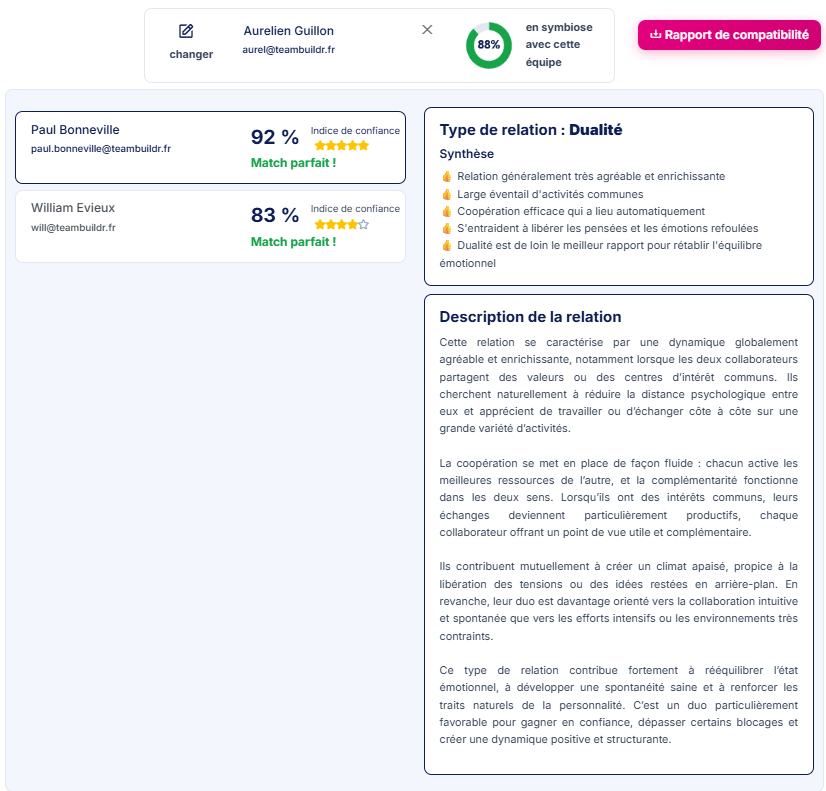
Understand affinity between collaborators
Compare profiles to identify natural collaboration facilitators and points that need clarification (communication, decision-making, pace, autonomy, conflict management).
Anticipate onboarding
Project the arrival of a new collaborator into a team, and prepare for onboarding and proximity management.
Guide adjustments
Transform relational insights into useful actions, such as clarifying roles, adjusting collaboration methods, adapting communication, or establishing a common framework.
Benefits
Why is it useful in companies and consulting firms?
Secure a decision without dehumanizing it
When multiple profiles are similar, team compatibility helps to inform the decision without replacing interviews or practical assessment.
Reduce post-hire friction
By identifying potential issues early on, you prepare for a more realistic integration and more adapted management.
Help managers lead the collective
The feature provides concrete support for discussing team functioning without remaining in ambiguity.
Provide a common basis for discussion
HR, managers, and consultants can rely on the same benchmarks for quicker alignment.
How it works
How does it work?
Step 1: Define the context
You start with an existing team, a pair to analyze, or a project to integrate a new profile.
Step 2: Have profile analyses available
The collaborators concerned have profile analyses in Trimoji (according to your process and configuration).
Step 3: Read the compatibility views
You consult the team-oriented views and deliverables to visualize affinity and collective dynamics.
Step 4: Take action
You use these elements to prepare interviews, frame onboarding, adjust organization, or support a manager.
Deliverables
Associated deliverables
Depending on your use case, team compatibility can be supported by deliverables such as:
- Team dynamics analysis
- Team report
- Relational compatibility report
- Onboarding report
These deliverables are used to share a clear reading and transform analysis into an action plan.
Applications
Use cases
Recruitment
Add a "collective" perspective at the end of the process to anticipate integration and prepare management.
Onboarding
Start on the right foot by clarifying success factors, collaboration styles, and points of attention.
Internal mobility
Secure a change of team or scope by objectifying compatibility points and support needs.
Reorganization or growth
Understand how the collective evolves with new roles, and where functional adjustments are needed.
Managerial support
Provide managers with concrete support to improve communication, coordination, and conflict management.
Frequently asked questions
FAQ
Does compatibility replace field experience?
No. It's a reading support. Work reality, context, and management remain determinant.
Is it only for recruitment?
No. It's also useful for onboarding, internal mobility, reorganization, and support.
Is it limited to an affinity of "getting along well"?
No. The goal is to understand collaboration modes, complementarities, and points of attention, not to predict a relationship.
How many people can be analyzed?
You can work on a pair or a team. The interest is to maintain an actionable reading, adapted to your context.
Do you want to better understand team dynamics and secure onboarding without losing the human element?