 trimoji
 Team Analysis
Introduction
What is this deliverable for?
The Team Analysis report is the deliverable dedicated to collective reading. It groups the personality profiles of several employees or candidates for a team-based interpretation: collective behavioral skills, profile diversity, distributed styles, and compatibility between members.
Two complementary versions are available:
- Team Soft Skills Analysis: collective behavioral assessment based on members' personality questionnaires.
- Team Hard Skills Analysis: assessment of collective technical skills based on analyzed CVs, with a comparison to an ideal CV profile.
These two reports can be generated separately or combined for a 360° view of a team.
Section Details
Team Soft Skills Report — Detailed Sections
1. Title Page
The cover identifies the report: team name, analysis type, and composition. The team type determines the sections displayed (standard, subgroups, compatibility analysis only, etc.).
2. Proximity Analysis (Optional)
For teams configured in subgroups, this section maps natural affinities between members based on their profiles. It helps identify behavioral proximity clusters before a global analysis.
3. Team Information
Team composition (list of members) and contextual information about the analyzed group.
4. Individual Profiles (one page per member)
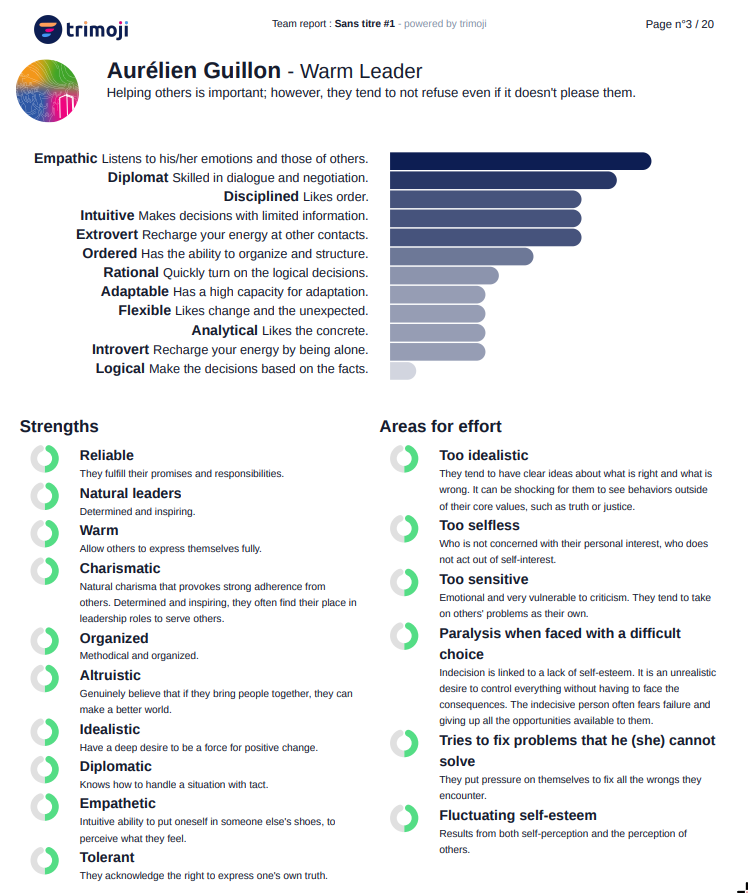
Each team member has their own profile sheet, represented in the collective report:
- Trimoji Portrait (name, type, profile mantra)
- Individual RADAR (12 dimensions, bars ranked by score)
- Highest Soft Skills (with candidate feedback)
- Areas for Attention (soft skills to monitor with feedback)
5. Collective RADAR
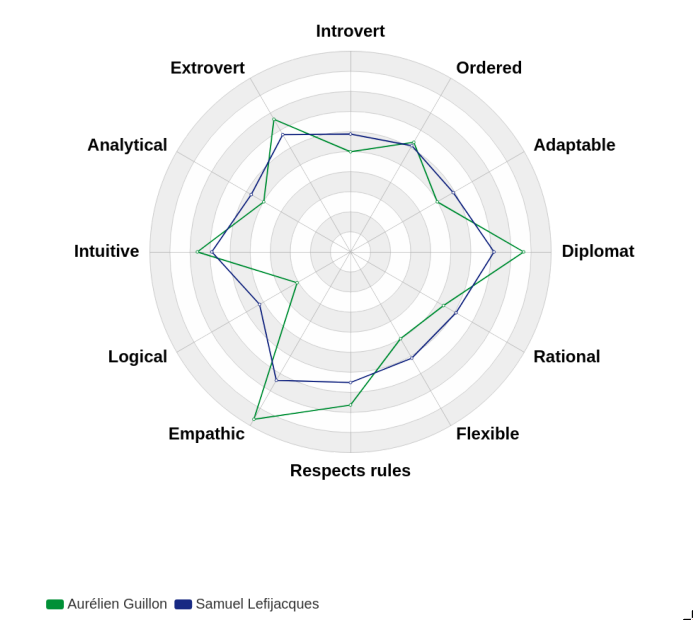
The RADAR is aggregated at the team level: each behavioral dimension displays the group's average score. This view helps identify dominant collective strengths and dimensions where the team is less represented or absent.
6. Collective 4 Colors
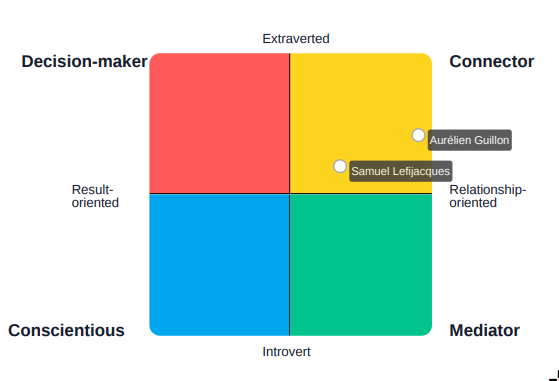
The 4 Colors map positions each team member on the behavioral spectrum (Dominant/Influential/Conscientious/Steady). The distribution of profiles on this map reveals the collective balance or imbalance: a highly "Dominant" team might be high-performing and competitive, but potentially difficult to coordinate.
7. 4 Colors Legend
A dedicated page explains the characteristics of each behavioral quadrant to aid in interpreting the map.
8. Collective Managerial Styles
This section positions team members according to their natural management tendencies. It helps identify who in the team has a managerial profile, which leadership style dominates, and which management skills are underrepresented.
9. Collective BIG 4
The four major personality dimensions are represented at the group level. This view helps understand the team's underlying trends on axes such as openness to change, collective orientation, or rigor.
10. Collective 4D (Cognitive Preferences)
The distribution of the 16 4D types within the team is presented. This helps identify the cognitive diversity of the group: intuitive vs. factual profiles, decision-oriented vs. harmony-oriented, organized vs. flexible.
11. Collective NEGOMAP
Each member's position on negotiation styles (NEGOMAP) is presented collectively. It identifies dominant styles in situations of tension or internal negotiation (Competition, Collaboration, Compromise, Accommodation, Avoidance).
12. Collective RIASEC
The distribution of the team's professional interests across the 6 RIASEC dimensions (Artistic, Investigative, Social, Enterprising, Realistic, Conventional). Useful for verifying alignment between members' aspirations and team missions.
13. Overall Compatibility
A compatibility matrix between all team members, expressed as a percentage with a color code. Four levels of interpretation:
- Ideal Match: high natural complementarity
- Good Match: good collaboration expected
- Adequate Relationship: no major obstacles, adjustments needed
- Low Compatibility: risk of tension, requires managerial attention
14. Individual Compatibility (one page per member)
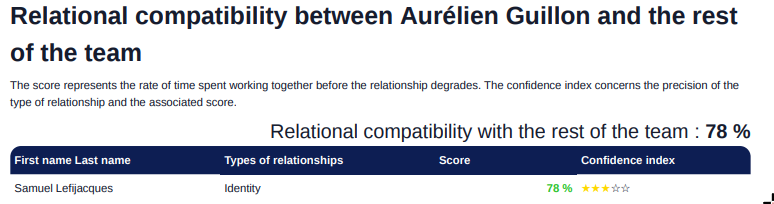
For each team member, a page details their compatibility with each colleague, along with a description of expected dynamics.
15. Compatibility Legend
A reference page explaining how to read and interpret compatibility scores in a professional context.
Section Details
Team Hard Skills Report — Detailed Sections
The hard skills report is generated from the analyzed CVs of the members. It focuses on capturing the team's collective technical skills.
1. Reference Job Brief (Optional)
If an ideal CV Job Brief was associated, it is displayed as a reference to allow for score interpretation against job requirements.
2. Individual Scores per Member
Each member's CV matching score is presented in a comparative table, with key indicators per person.
3. Collective Technical Skills
The aggregated list of the team's hard skills, with their average score. Useful for identifying collective technical strengths and gaps.
4. Collective Knowledge
Aggregated view of the team's knowledge (tools, methodologies, areas of expertise).
5. Individual CVs
The structured CVs of each member are integrated into the report in a standardized format.
How it works
How does it work?
Step 1 — Team Formation
The recruiter or manager creates a group in Trimoji and adds members (existing employees or candidates). Each member must have completed their personality questionnaire and/or have their CV analyzed.
Step 2 — Report Generation
Trimoji aggregates profiles, calculates collective scores, and pairwise compatibilities between all members. The report is generated automatically.
Step 3 — Utilization
The report is used in team sessions, management committees, or team-building sessions. It serves as a basis for discussing collective dynamics and managerial action plans.
Advantages
Benefits for HR and Management Teams
- 360° Team Vision: behavioral skills, technical skills, and compatibility in a single document.
- Identification of Imbalances: over-represented or absent profiles in the team to guide future recruitment.
- Tension Management: anticipate at-risk pairings and manage them managerially before they lead to conflicts.
- Targeted Team Building: objective basis for structuring collective intelligence or development sessions.
- Complementary Recruitment: know which type of profile is missing in the team before launching a recruitment.
Examples
Use Cases
Forming a New Project Team
Before forming a team, analyze the compatibility between prospective members and balance behavioral profiles to maximize cohesion.
Diagnosing an Existing Team
A manager taking over a team can generate the report for an immediate snapshot of the current dynamics.
Preparing for Recruitment
Identify missing profiles in a team before launching recruitment: what behavioral style, cognitive type, or technical skills are lacking?
Supporting Team Building / Coaching
Consultants and coaches use the team report as a basis for facilitating collective intelligence or team development sessions.
Frequently Asked Questions
FAQ
How many members can a team have?
Up to about twenty members depending on configurations. For large teams, it is recommended to work in subgroups to maintain the readability of the compatibility matrix.
Can the report include candidates (not yet in position)?
Yes. It is possible to simulate the addition of a candidate to an existing team to assess the impact on dynamics before the recruitment decision.
Does a low compatibility score disqualify a candidate?
No. Compatibility is an indicator, not an absolute criterion. Some distant profiles bring valuable cognitive diversity. The score guides reflection; it does not replace the manager's or recruiter's judgment.
Do you want to analyze your teams' dynamics and manage your recruitments with a collective vision?
Request a Demo