 trimoji
 Soft skills analysis
The Trimoji Personality Analysis report is the central deliverable from the personality questionnaire. It transforms a candidate's or employee's responses into a structured, readable, and shareable document designed to support HR and managerial decisions.
The goal is not to "grade" a profile, but to offer a comparable and reasoned interpretation. The report provides a common frame of reference for recruiters, managers, and HRBPs, including: relational posture, operating preferences, favorable environments, motivational drivers, management styles, and areas of caution.
It can be used at all stages of the HR lifecycle: selection, debriefing, onboarding, internal mobility, or managerial development. Depending on the chosen version, the document ranges from a quick summary to a comprehensive multi-grid report.
Overview
Report content, section by section
1. Introduction Page
The first page contextualizes the document. It includes: the full name of the profile, the date of the personality questionnaire completion, the estimated duration of the format used (short version ~ 3 minutes or long version ~ 15 minutes), and the actual time spent by the candidate. The client company's logo is displayed at the top.
If the web profile is accessible, a direct link is provided for stakeholders wishing to consult the online version.
When the report version includes the candidate's feedback, a legend is displayed on this page to help readers interpret the evaluation icons (5 levels of the candidate's perception of their own tendencies).

2. The Trimoji Portrait
This section presents the personality profile identified by the questionnaire. It includes an illustration of the type, its name, a concise description, and associated behavioral categories.
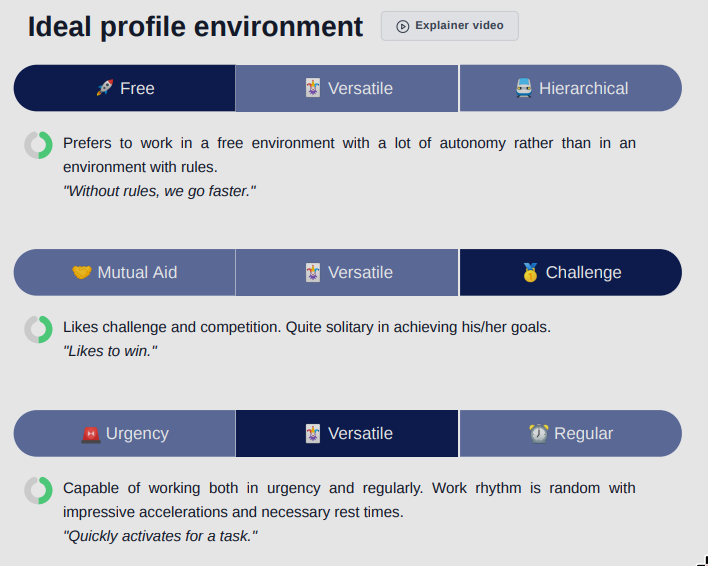
The Trimoji portrait is then detailed around three natural "habits":
- Environment Style: The profile is positioned on an axis from a free and autonomous environment to a hierarchical and procedural framework, with a versatile posture in between. A description and a mantra quote illustrate the dominant trend.
- Motivation Style: The profile is positioned between motivation through teamwork and cooperation, an adaptable posture, and motivation through individual challenge. Similarly, a description and a mantra quote complete the interpretation.
- Work Pace: The profile is situated between operating under urgency and reactivity, adaptability to pace, and a regular and planned mode. A description and a mantra quote personalize the interpretation.
Each of these three habits includes, if activated, the candidate's feedback icon indicating whether they recognize themselves (or not) in the identified tendency.
The section concludes with the environments that are favorable and unfavorable to the profile, with the option to display the candidate's perception of these descriptions.
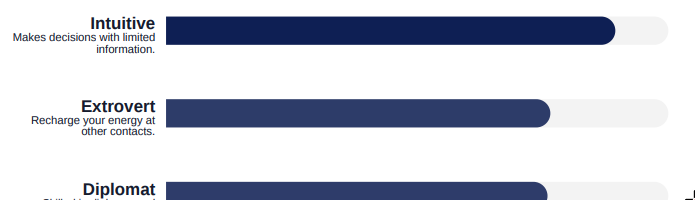
3. The RADAR Synthesis (12 Dimensions)
The RADAR is Trimoji's proprietary grid. It presents 12 behavioral dimensions ranked by relevance for the analyzed profile, in the form of horizontal bars. Each dimension is accompanied by a score (in %) and a brief description.
This view is one of the most effective for a quick initial read: it allows for identifying the five or six most prominent traits of a profile in seconds and situating the differences between strong, average, and weak tendencies. It also serves as a basis for comparisons between candidates.
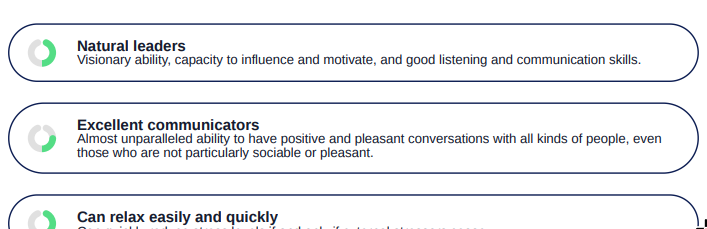
4. Valued Soft Skills
This section lists the soft skills naturally associated with the profile: the behavioral competencies that the person tends to express spontaneously. Each soft skill is presented with its title and a detailed description of its manifestation at work. If feedback is enabled, the candidate indicates whether they recognize themselves in each listed soft skill.
This is a particularly useful section for interview preparation and for highlighting the profile in a recommendation letter.
5. Areas of Caution
Mirroring the soft skills, this section presents the so-called "at risk" soft skills: behaviors that are less natural or more energy-consuming for this profile. Each is accompanied by a description that helps understand the context in which this limitation may appear. Here too, candidate feedback can be displayed.
This section is invaluable for structuring an integration plan or anticipating development areas from the outset (onboarding).
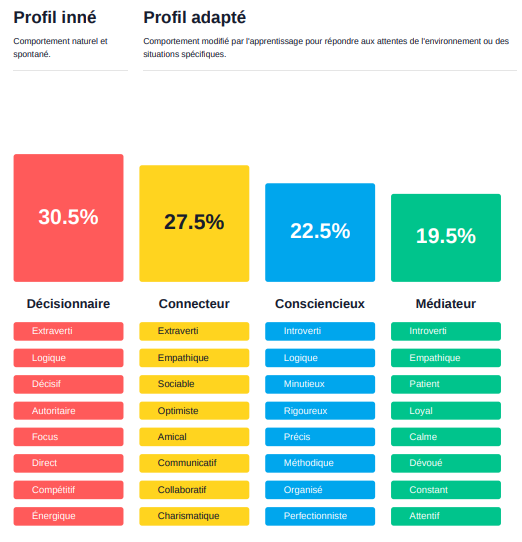
6. The 4 Colors Grid — Behavioral Positioning
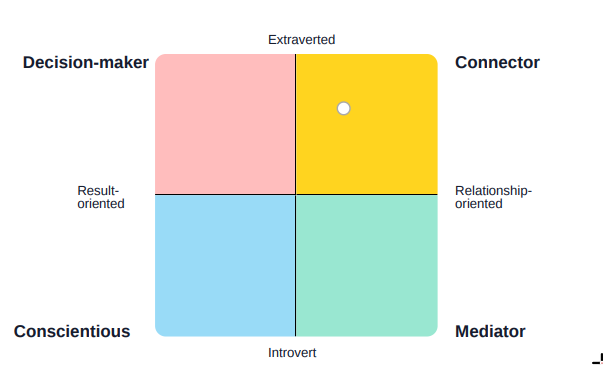
The 4 Colors grid is a behavioral mapping. The profile is positioned on a plane with two axes (results-oriented vs. people-oriented; extraversion vs. introversion), allowing visualization of its dominant positioning among four quadrants:
- Decision Maker: results-oriented, direct, decisive.
- Connector: people-oriented, communicative, enthusiastic.
- Conscientious: quality-oriented, methodical, analytical.
- Mediator: harmony-oriented, reliable, supportive.
The cursor on the graph shows the exact position of the profile, which may lie across several quadrants.
7. The 4 Colors Grid — Detailed Analysis of Parameters
The following page details the scores for each of the four quadrants and distinguishes between the innate profile (natural behavior under pressure) and the acquired profile (adapted behavior in a comfort context). Each quadrant is accompanied by a list of characteristic behavioral traits.
8. The Profile as an Employee
This section describes how this profile behaves in daily work situations: their contribution style, their expectations of the work environment and their manager, and their ways of organizing themselves. This is directly usable information for recruitment interviews and onboarding.
9. The Profile as a Colleague
This section describes the relational dynamics that this profile will naturally generate within a team: their way of collaborating, communicating, and taking their place in a team. It is useful for assessing cultural fit and complementarity with the existing team.
10. The Profile as a Manager
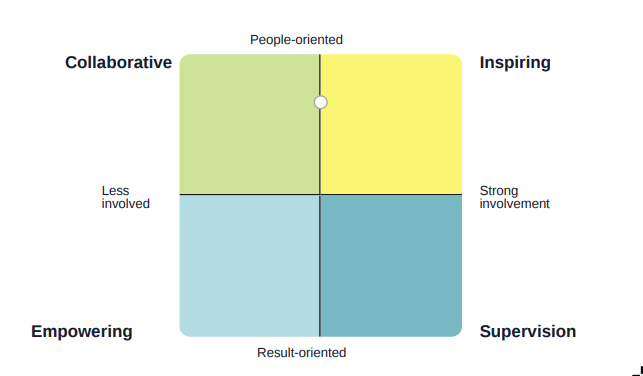
This section presents the profile's natural management style. It is accompanied by a second positioning graph, specific to the managerial context, with four postures:
- Collaborative: intervenes little, lets things happen, supports.
- Inspiring: people-oriented, intervenes a lot, persuades.
- Empowering: results-oriented, fosters autonomy.
- Supervisor: strong framework, high demands.
The textual description details the expectations and probable behaviors in a management role, which is useful for leadership positions or internal promotion projects.
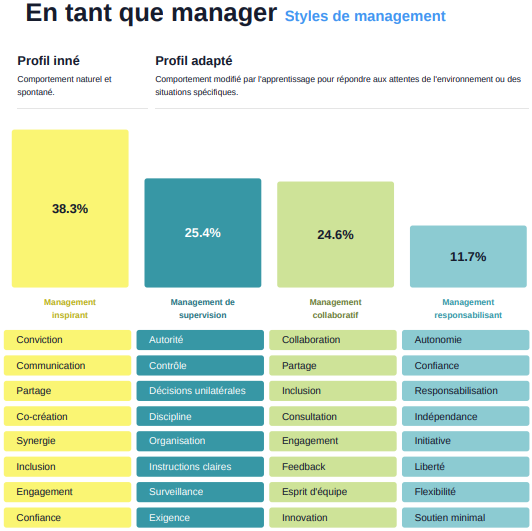
11. The Profile as a Manager - Detailed Analysis of Parameters
The following page details the scores for each of the four quadrants and distinguishes between the innate profile (natural behavior) and the acquired profile (adapted behavior in a comfort context). Each quadrant is accompanied by a list of characteristic behavioral traits.
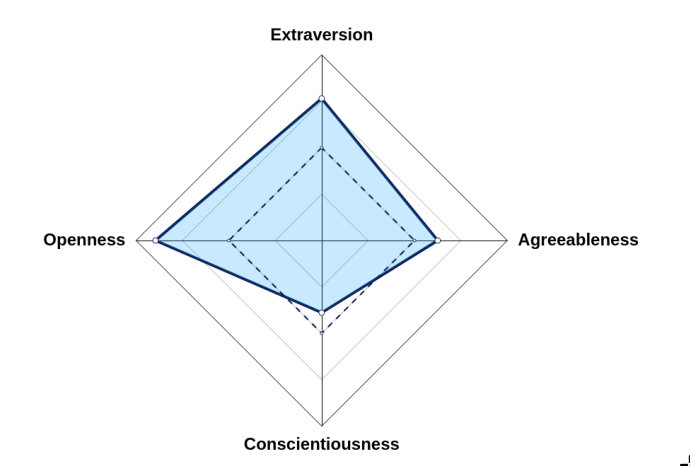
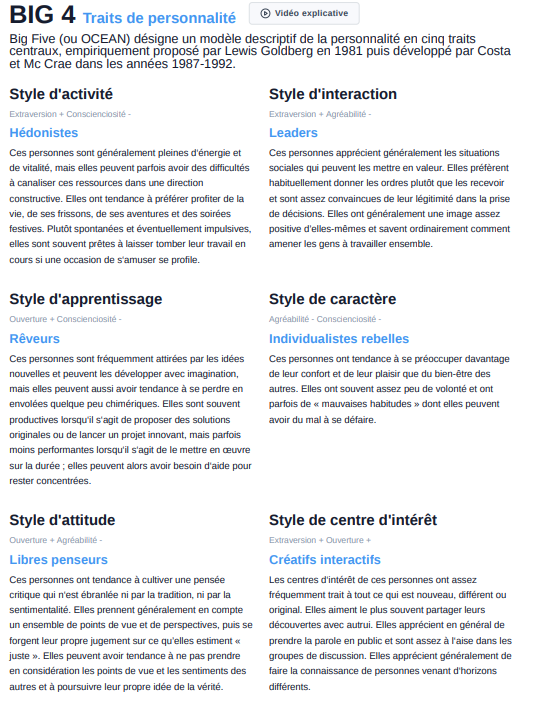
12. The BIG 4 - Radar Graph
The BIG 4 is a structured reading around four major personality dimensions: Extraversion, Openness, Conscientiousness, and Agreeableness. These four dimensions are represented in a radar format, allowing for a quick visualization of balances. For each dimension, a comment adapted to the score level indicates practical implications.
13. The BIG 4 - Detailed Styles
This page, a breakdown of the BIG 4, presents six secondary dimensions: Activity, Interaction, Learning, Nature, Attitude, and Interest. Each is supplemented by a category subtitle, a representative adjective, and a behavioral description. The entire provides a global yet nuanced reading of personality.
14. The NEGOMAP
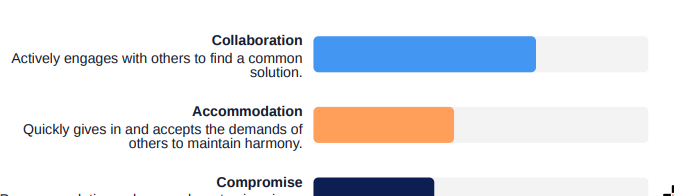
The NEGOMAP identifies the profile's natural conflict resolution and negotiation style.
Five orientations are measured and ranked by score:
- Competition/Confrontation: asserts their position, seeks to win.
- Collaboration: seeks a mutually satisfactory solution.
- Compromise: accepts a partial agreement to move forward.
- Accommodation: yields to preserve the relationship.
- Avoidance: prefers not to confront disagreement.
Each dimension is displayed with a percentage score, a visual bar, and a detailed description.
This module is particularly relevant for positions involving negotiations, managing complex teams, or sales roles.
15. The 4D — Cognitive Preferences
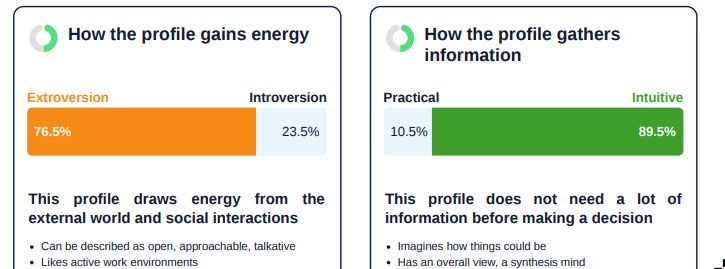
The 4D module analyzes four pairs of cognitive preferences:
- Extraversion vs Introversion - orientation of energy outward or inward.
- Concrete vs Intuitive - processing information through tangible facts or through concepts and possibilities.
- Logical vs Affective - decision-making based on logic or relational values.
- Organized vs Flexible - relationship with schedules, rules, and improvisation.
For each pair, a bar graph indicates the percentage of each pole. The dominant letter is highlighted, accompanied by a description, a list of associated strengths, and a list of points of attention. If feedback is enabled, the candidate can indicate their perception on each of the four axes.
16. The RIASEC — Professional Interests
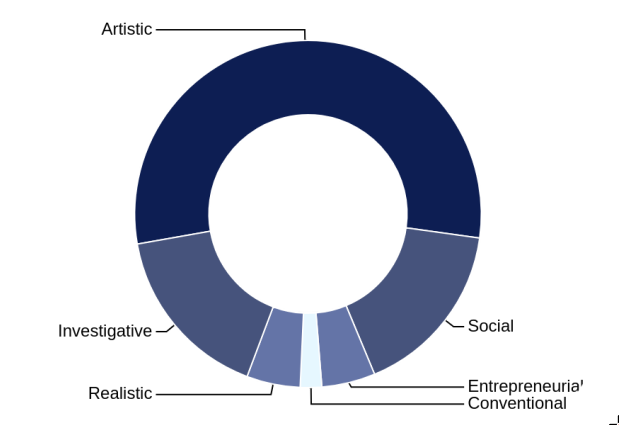
The RIASEC module measures the profile's dominant professional interests. Six dimensions are evaluated, presented in a circular graph format and with explanations per dimension:
- Artistic: creativity, expression, originality.
- Investigative: analysis, research, intellectual curiosity.
- Social: helping, teaching, relating to others.
- Enterprising: leadership, persuasion, risk-taking.
- Realistic: concrete, technical, handling objects.
- Conventional: organization, precision, adherence to procedures.
The RIASEC helps validate the alignment between a candidate's deep interests and the actual duties of the position.
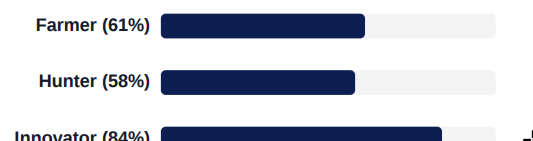
17. The Sales Profile
This module positions the profile on five sales archetypes, each measured in percentage:
- Account Manager: maintains and develops existing accounts.
- Hunter: prospects and acquires new clients.
- Innovator: brings new solutions and thinks "out of the box".
- Networker: relies on their network and relationships to sell.
- Analyst: sells through proof, data, and rigor.
This module is activated for profiles in sales roles or customer-facing positions. It helps assess natural alignment with the type of sales expected for the position.
18. The Drivemap — Drivers of Meaning at Work
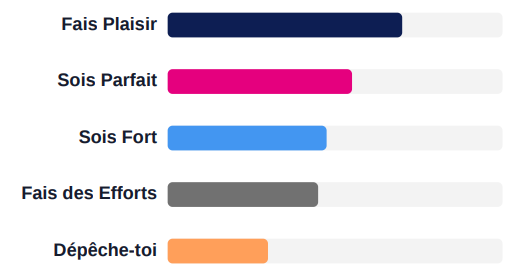
The Drivemap is an optional module that requires a dedicated complementary personality questionnaire. It measures five drivers of meaning and contribution: Strategy and Performance, Unifying Force, Innovation Force, Driving Force, and Talent Direction. Each driver is measured on 40 points and illustrated with a detailed description. This module is particularly useful in leadership contexts, for mobility projects, or managerial development.
Report Formats
The 3 available versions
Essential Version
The Essential version is designed for quick decisions. It includes the most discriminating pages for an initial screening or pre-selection: the RADAR (12 dimensions), the 4 Colors grid, and the BIG 4. Candidate feedback is visible. This version is ideal for high-volume contexts, early stages of a recruitment process, or situations where multiple profiles need to be compared quickly.
Complete Version
The Complete version activates all available modules: Trimoji portrait, RADAR, soft skills, areas of caution, 4 Colors (graph + parameters), employee/colleague/manager profiles, BIG 4, NEGOMAP, 4D, RIASEC, sales profile. Candidate feedback is displayed on all relevant sections. This version is recommended for high-stakes recruitment, in-depth debriefings, managerial feedback, and internal mobility projects.
Custom Version
The Custom version is driven by the settings of your organization (company or recruitment campaign). The activated sections, the level of detail, and whether to display candidate feedback are configured according to your business needs. This version allows each company to have a report tailored to its practices, without altering the common data architecture.
Workflow
How to access this report?
Step 1 - Personality Questionnaire Completion
The candidate or employee answers the Trimoji personality questionnaire. Two formats are available: a short version of approximately 3 minutes and a long version of approximately 15 minutes. The actual completion time is recorded and visible in the report. Certain additional modules (Drivemap, RIASEC) may involve a separate questionnaire, activated according to your campaign configuration.
Step 2 - Indicator Calculation and Assembly
The Trimoji engine analyzes the responses and calculates all indicators: dominant profile, RADAR scores, 4 Colors positioning, BIG 4 values, NEGOMAP and 4D scores, RIASEC interests, and sales archetypes. The algorithms avoid ambiguous values and perfect ties to produce a consistently usable interpretation. Results are enhanced with feedback if it has been collected from the candidate.
Step 3 - Application of the Chosen Version
The report is automatically generated in PDF format according to the selected version (Essential, Complete, or Custom). Activated sections are automatically numbered and ordered. When feedback is disabled in the configuration, the icons are neutralized to present a report without candidate validation bias.
Step 4 - Utilization and Sharing
The PDF is accessible from the Trimoji platform or directly within your ATS candidate file, depending on your integrations. It can be shared with stakeholders in the process (manager, HR director, selection committee) to align interpretation before an interview, debriefing, or hiring decision. If the profile allows, a link to the interactive web version is also available on the introduction page.
Benefits for HR Teams
Benefits for an HR Team
- Homogeneous interpretation among recruiters, managers, and HRBPs, regardless of their evaluation experience.
- Time savings on debriefings: the report structures discussions and avoids lengthy debates on unsubstantiated impressions.
- Better-documented decisions: visible indicators allow for substantiating a shortlist or rejection based on objective criteria.
- A multi-purpose tool: the same report serves for selection, then onboarding, then managerial follow-up without needing a new assessment.
- Contextual adaptation: the Essential version for initial screening, the Complete version for high-stakes situations, the Custom version for your internal processes.
- Interview support: the "as an employee", "colleague", and "manager" sections can be directly used to prepare targeted questions.
Practical Applications
Use Cases
High-Volume Recruitment
Use the Essential version to process a large flow of applications. The RADAR and soft skills allow for a quick initial read without going into detail on each profile. The most relevant candidates can then be examined with the Complete version.
Executive or Managerial Recruitment
The Complete version provides the necessary depth for a high-stakes position. The 4 Colors module, BIG 4, and Manager section are useful for projecting the candidate into the role and preparing a well-substantiated debriefing with the decision-making committee.
Recruitment Agencies
The report integrates easily into a candidate presentation file. The structured reading reduces reformulation time and enhances the quality of recommendations. The Custom version allows tailoring the output to each client's expectations.
Internal Mobility
Compare an employee's profile with the requirements of the new position. The Manager and NEGOMAP sections are particularly useful for roles involving increased responsibility or a transition to management.
Onboarding and Development
Share the report with the manager upon the employee's arrival. The areas of caution and soft skills guide the creation of a tailored onboarding plan. The Drivemap (if activated) helps identify the drivers of meaning to nurture from the first weeks.
Frequently Asked Questions
FAQ
Is the report always the same for the same profile?
No. The content of the sections depends on the chosen version (Essential, Complete, or Custom) and your organization's settings. However, the underlying data remains stable for the same candidate.
What does the feedback icon in the report mean?
It represents the candidate's perception of the described tendency: from "do not recognize myself at all" to "recognize myself completely". This information enriches the interpretation and opens a discussion with the candidate during the interview. If the chosen version does not include it, all icons are neutralized.
Are all modules always available?
No. The Drivemap requires a specific complementary assessment and must be activated in the campaign settings. The RIASEC also requires a dedicated assessment. The sales profile is displayed based on your organization's configuration.
Can the report be anonymized?
Yes. If the anonymization option is enabled, the candidate's name is replaced by an alias, and the link to their web profile is hidden. This option is useful in double-blind processes or for contexts requiring equal treatment.
Can the personality questionnaire be retaken to update the report?
Yes. A history of assessments is kept in the database. If a new personality questionnaire is completed, a new report can be generated. Comparing versions can be insightful for observing an employee's evolution over time.
Does this report replace the recruitment interview?
No. It is a structured support for decision-making, not a substitute for human judgment. It should be cross-referenced with the CV, interview findings, references, and the operational context of the position.
Do you want to structure your HR decisions with Trimoji personality deliverables?
Request a demo