 trimoji
 Job Brief (Hard Skills): The Ideal CV Formalized
Deliverable Objective
What is this deliverable for?
The Job Brief (Ideal CV) is the technical skills framework used to define the ideal CV profile for a position. It formalizes the hard skill requirements of a recruitment into precise, comparable, and "scoreable" criteria.
Just as the Soft Skills Job Brief defines behavioral expectations, the Ideal CV Job Brief defines technical requirements: skills, knowledge, education, languages, experience, contract type, location, and cognitive profile preferences.
This brief becomes the reference for comparison when candidate CVs are analyzed by Trimoji: each CV is automatically compared against the brief's criteria to produce a hard skills "matching" score.
Detailed Content
What the report contains, section by section
1. Job Identification Page
The report begins with contextual information about the position: job title, company, industry, department, location, and geographical search radius (
2. Job Conditions
Recruitment conditions are formalized:
- Expected Contract Type(s) (permanent, fixed-term, freelance, apprenticeship, etc.)
- Driving License (required or optional)
- Required Languages (with mention of mandatory/preferred)
- Industry or job-specific keywords (mandatory or optional)
- Desired Start Date (earliest or specific date)
- Remote Work (full, partial, none)
- Target Salary (min-max range)
- Geographical Area (if applicable)
3. Weighting of Requirement Levels
A weighting graph indicates the relative priority of the different brief criteria. This allows for calibration of the scoring: two positions with the same skills but different weightings will produce different "matching" results, reflecting the actual recruitment priorities.
4. Target Soft Skills (Behavioral Dimension)
The brief can include expected soft skills for the position, drawn from the Trimoji repository. This section allows for the articulation of technical expectations with behavioral expectations, even though the Ideal CV brief primarily focuses on hard skills.
5. Target Cognitive Profile (Optional)
If a personality dimension has been associated, a graph of the expected cognitive preferences (4D) for the position is displayed.
6. Experiential Requirements
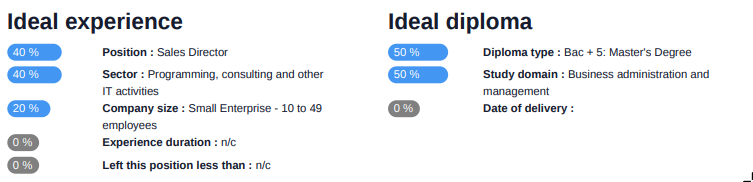
Criteria related to professional experience are described with their weighting score:
- Required Position: job title or expected job family (with target matching score)
- Industry: target industry with weighting
- Company Size: preferred organization size (start-up, SME, large corporation)
- Years of Experience: minimum months/years of experience
- Recency of Position: maximum time accepted since the last comparable role
7. Educational Requirements
Academic criteria are formalized with their weighting: degree level (ISCED type), field of study (CIP code), and maximum graduation year (for recent graduates or recruitments with seniority criteria).
8. Target Technical Skills (Hard Skills)
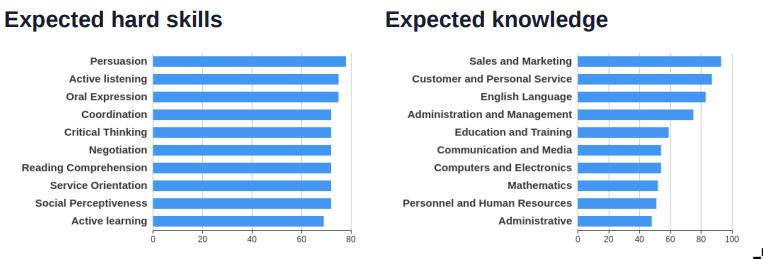
The core of the brief: the list of technical skills expected for the position, each with its target score in percentage. The higher the score, the more critical the skill. These skills will be automatically compared to the skills extracted from each candidate's CV.
9. Target Knowledge (Knowledges)
In addition to hard skills, the expected theoretical knowledge, tools, and methodologies are listed with their weighting.
How it works
How does it work?
Step 1 — Configure the Brief
The recruiter enters the job criteria into Trimoji: skills, education, experience, languages, conditions. They assign weightings according to recruitment priorities.
Step 2 — Generate the Brief
The brief is generated in PDF format with all formalized criteria. It is timestamped and identified by the job title.
Step 3 — Compare with Candidate CVs
Each CV uploaded into Trimoji is automatically compared against the brief's criteria. A hard skills "matching" score is calculated for each candidate, taking into account the defined weightings. This score populates the Candidate Dossier and can be viewed directly in the interface.
Key Advantages
Benefits for an HR Team
- Formalized Technical Criteria from the start of recruitment, avoiding disagreements during the process.
- Automatic CV Scoring: each analyzed CV receives a score against the brief without manual intervention.
- Weighting of Priorities: a role where language is critical will be weighted differently than one where it's a plus.
- Alignment Between Recruiter and Manager: the brief structures the conversation on what's truly important before starting the search.
- Reusable: an approved brief can be reused for future recruitments for similar positions.
Concrete Applications
Use Cases
Technical Recruitment
Precisely define the expected skills for an engineering, developer, or expert position before processing applications. Automatic scoring speeds up initial screening.
Consulting Firms and Specialized Agencies
Create a brief for each client assignment and compare your consultant pool to identify the profiles best suited for each mission.
International Recruitment
Incorporate language requirements and geographical criteria into the brief to automatically filter applications based on these constraints.
Frequently Asked Questions
FAQ
What is the difference with the Soft Skills Job Brief?
Both briefs are complementary. The Ideal CV Brief focuses on technical skills, education, and experience. The Soft Skills Brief focuses on the behavioral profile. Both can be combined in the Candidate Dossier for a two-dimensional scoring.
How many skills can be included in a brief?
As many as needed. However, it is recommended to focus on the 5 to 10 truly differentiating skills to maintain readable and meaningful scoring.
Can the brief be modified after the first applications?
Yes. If the market reveals that certain criteria are unattainable or less relevant, the brief can be adjusted, and the "matching" scores will be recalculated.
Would you like to define your technical requirements and automatically score your candidates' CVs?
Request a Demo