 trimoji
 Job Brief (Soft Skills)
Objective
What is this deliverable for?
The Job Brief (soft skills) is the reference document that formalizes the ideal personality profile sought for a given position. It translates the behavioral and relational expectations of a recruitment into comparable and measurable criteria.
Rather than vaguely describing "an organized and autonomous person," this deliverable formalizes the operating preferences, behavioral styles, and expected dispositions on each of the Trimoji grids. It becomes the stable reference for aligning all evaluators on the same criteria, regardless of their subjective perceptions.
This brief is used upstream of the process, before personality questionnaire assessments, to calibrate the selection. It can also serve as an anchor during debriefings or candidate comparisons.
Structure
What the report contains, section by section
1. Header Page
The report opens with the job title and company name, the brief creation date, and the organization's logo. This page serves as a cover page for sharing the brief internally or with recruitment partners.
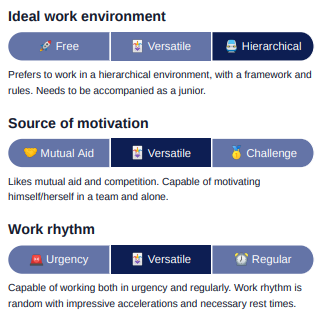
2. Target Trimoji Habits
The brief formalizes the expected operating preferences across three axes:
- Environment Style: the team defines whether the position calls for a profile comfortable in a free and autonomous environment, versatile, or conversely, structured and hierarchical.
- Motivation Style: the brief specifies whether the position is better suited for someone motivated by teamwork and cooperation, individual challenge, or a hybrid approach.
- Work Pace: it indicates whether the position requires a profile capable of operating under pressure and with reactivity, a regular and planned pace, or adaptability to both.
3. The Target RADAR (12 Dimensions)
The brief defines the expected levels for each of the 12 behavioral dimensions of the Trimoji RADAR. The most important dimensions for the position appear with a high score, and the least critical with a lower score. This RADAR becomes the comparison benchmark when candidates take their personality questionnaire: their profile is positioned against this target.

4. Target Soft Skills
The brief lists the expected behavioral soft skills for this position. These skills are selected from the trends associated with the target 4 Colors profile. Each soft skill is displayed with its title to allow for quick reading and alignment among evaluators.

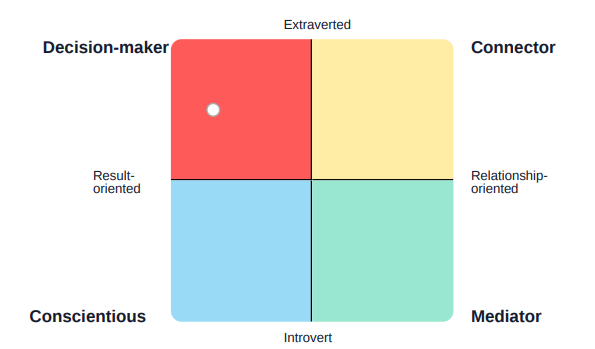
5. The 4 Colors Target
The brief positions the behavioral expectations on the 4 Colors map. A slider indicates the ideal positioning of the desired profile among the four quadrants. The activated quadrants are highlighted, along with their associated behavioral descriptions.
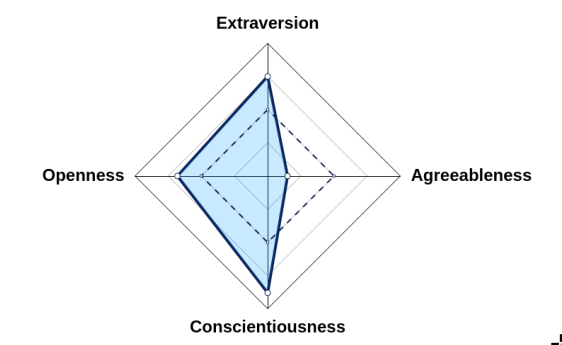
6. The BIG 4 Target
The brief specifies the desired dispositions on the four major personality dimensions of the BIG 4: Extraversion, Openness, Conscientiousness, and Agreeableness. These benchmarks help refine the expected profile beyond observable behaviors, by integrating underlying tendencies.
How it works
How to get it?
Step 1 - Define expectations for the position
The recruiter or manager sets up the brief via Trimoji: job title, company, target Trimoji habits, expected 4 Colors positioning, desired RADAR levels. This can be done alone or in collaboration with the operational manager.
Step 2 - Generate the job brief
The brief is automatically generated in PDF format from the settings entered in your Personi space. It is time-stamped and identified by the job title for easy retrieval and sharing.
Step 3 - Use the brief as a reference
Candidate profiles are then compared to this brief: their personality questionnaire generates a soft skills matching score against the defined expectations. The brief also serves as a reference during debriefings and shortlist decisions.
Benefits
Benefits for an HR Team
- Formalized behavioral criteria from the start of recruitment, avoiding disagreements during the process.
- Alignment between recruiter and manager on what "the right profile" means in concrete terms.
- Stable comparison base for evaluating multiple candidates on the same axes.
- Time savings on debriefs: the brief structures the discussion around objective criteria.
- Reusable from one recruitment to another for the same type of position or profile.
Uses
Use Cases
Executive or Manager Recruitment
Align the management committee on behavioral expectations before meeting candidates. The brief is presented at the recruitment kickoff to ensure everyone evaluates the same criteria.
Recruitment Agencies
Formalize behavioral expectations with the client from the moment the mandate is taken. The brief structures the needs qualification and reduces back-and-forth during the mission.
Recurring Recruitment
Leverage a validated brief to speed up future recruitments for the same type of position.
Frequently Asked Questions
FAQ
Is the job brief linked to candidate personality questionnaires?
Yes. Once the brief is created, it serves as the reference for scoring candidate soft skills. Their profile is automatically compared to the target positioning defined in the brief.
Who writes the job brief?
The recruiter, in collaboration with the operational manager. Trimoji supports this work with guided setup options. The brief can be adjusted until it is used for matching.
Can multiple briefs be created for the same position?
Yes. It is possible to create variations depending on team contexts, missions, or a manager's specific expectations.
Does the brief impose a unique profile?
No. It defines a target profile, but the recruiter remains free to interpret deviations. A candidate far from the target on one axis may have other qualities that compensate depending on the context.
Want to formalize your job profiles and manage your recruitments with clear behavioral criteria?
Request a demo