 trimoji
 Onboarding Report
The Onboarding report is a personalized integration guide, automatically generated from an employee's personality profile. It is designed to be given to the manager who welcomes a new member into their team.
This document answers a practical question: "Now that I know the profile of the person joining, how can I tailor their onboarding?". It translates behavioral indicators into practical actions, with specific advice for each phase of the new role.
It is a deliverable for operational managers: it does not require prior training in Trimoji frameworks to be used.
What the report contains, section by section
1. Cover Page - 3 Keys to Interpretation
The first page identifies the report (employee's name, company logo) and presents three keys to using the document. These three keys contextualize the report's use for a manager encountering it for the first time: how to interpret it, how to use it, and with what mindset to approach the onboarding.
2. Behavioral Summary
This section provides a concise overview of the profile:
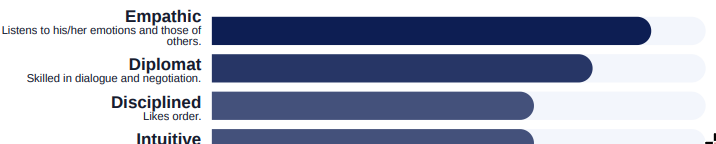
- RADAR (12 Dimensions): the most pronounced behavioral tendencies, ranked by score, offer a quick view of the employee's natural strengths.
- Trimoji Habits: positioning on the three axes (environment style, motivation, work pace) with descriptions of favorable/unfavorable environments.
This section allows the manager to grasp the new employee's natural preferences in a few minutes.
3. Behavioral Descriptions in Context
This section delves into three aspects:
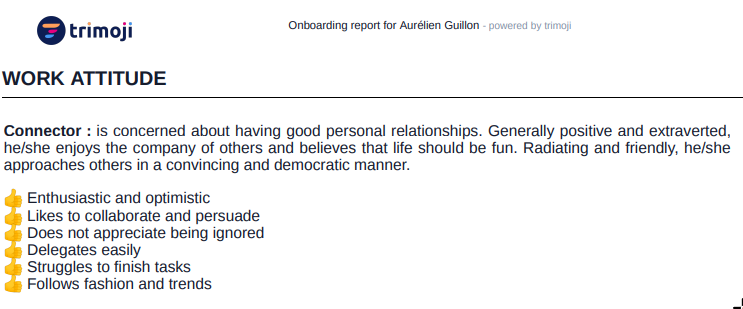
- Work Attitude: description of the employee's behavioral style based on their 4 Colors positioning, along with associated behavioral traits.
- Communication Style: what facilitates interaction with this profile (what they appreciate, what makes them comfortable) and sources of stress to avoid (what causes tension or disengagement).
- Personality at Work (BIG 4): interpretation of the four personality dimensions adapted to the professional context. For each dimension, a natural phrasing indicates whether the employee is generally high or low on that axis and what this concretely implies.
4. 5-Phase Onboarding Plan (Advice)
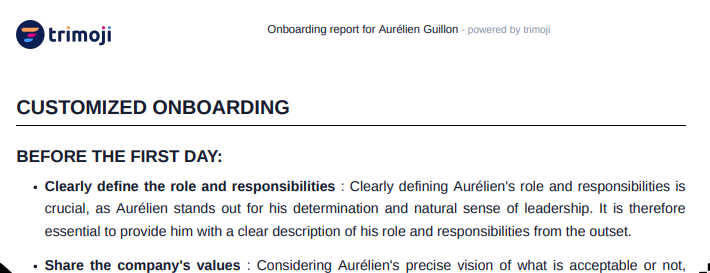
The actionable core of the report: Five sets of three personalized tips, structured by onboarding phase. Each tip is presented with a title and detailed description.
- Before the First Day: actions to prepare in advance to ensure the person starts under the best conditions according to their profile (communication, work environment, expectation setting...).
- The First Day: behaviors to adopt during the welcome to create the right relational conditions from the start.
- The First Week: follow-up actions to anchor the integration over time and detect early positive or negative adaptation signals.
- After 15 Days: adjustment actions to conduct an initial review of the role assumption, identify potential friction points, and strengthen the employee's integration into the team and their responsibilities.
- After 1 Month: consolidation actions to confirm a good understanding of the role, validate initial results, and durably establish the employee in a dynamic of autonomy and performance.
How does it work?
Step 1 - Administer the personality questionnaire
The employee completes the personality questionnaire. This questionnaire may have been taken during the recruitment process or at the beginning of the onboarding.
Step 2 - Automatic report generation
The onboarding report is automatically generated from the profile. The advice is personalized according to the identified behavioral specificities: each deliverable is unique.
Step 3 - Provide to the manager
The PDF is sent to the manager before the employee's arrival. It can be read in 10 minutes and directly serve as a practical guide without requiring additional training.
Benefits for HR and Management Teams
- Better Prepared Onboarding: the manager comes with prior knowledge of the profile and concrete actions to implement.
- Less Improvisation: the advice structures a period where the quality of the welcome significantly impacts engagement and retention.
- Accessible Without Expertise: the manager does not need to be familiar with Trimoji frameworks to apply the advice.
- Strong Signal for the Employee: a tailored onboarding from the start reinforces the feeling of being expected and understood.
- Reduced Risk of Early Resignation: personalized onboarding helps secure the initial weeks, which are often crucial for retention.
Use Cases
Onboarding a Permanent Employee (CDI)
As soon as the contract is signed, generate the report and send it to the manager and the HR team. The document frames the first weeks of integration and facilitates initial interactions.
Internal Mobility
An employee changing roles or managers benefits from the same support as a new recruit. The onboarding report helps the new manager adapt their approach from the outset.
Managerial Role Assumption
A manager taking on a new role can use the onboarding reports of their future team members to prepare their initial interactions and adapt their management style from the start.
FAQ
Is the onboarding report different from the full personality report?
Yes. It is geared towards integration and management, with a practical focus (advice) rather than an exhaustive analysis. It is intended for the manager, not HR or recruiters.
Are the tips generic or personalized?
Fully personalized according to the employee's profile. Two individuals with different profiles will receive different advice.
Can the employee see this report?
This is a decision for the organization. The report is designed for the manager, but some companies choose to share it with the employee as part of a transparency and self-development initiative.
Would you like to personalize the onboarding of each new employee from their very first day?
Request a Demo