 trimoji
 Analyze personality for better professional understanding
Analyzing personality helps to better understand how a person functions at work, beyond the CV and job titles. In an HR, recruitment, or coaching context, Trimoji helps structure this analysis to obtain more readable, comparable, and actionable benchmarks.
Trimoji does not replace the recruiter, coach, or manager. Personality analysis serves as a support to prepare for discussions, formulate hypotheses, and verify them in an interview or in situ, without ever reducing a person to a simple result.
Do you want to analyze personality in a structured and actionable way, without losing the human factor?
Usage Contexts
When to use personality analysis?
- ⏩ Recruitment for sensitive or high-stakes positions (interpersonal, pressure, autonomy).
- ⏩ Decision-making between 2 or 3 finalists with similar CVs.
- ⏩ Onboarding and integration, to prepare for success.
- ⏩ Internal mobility, when projecting into a new context is necessary.
- ⏩ Coaching, skills assessment, and individual support.
- ⏩ Teambuilding or improving collaboration (understanding different working styles).
Our Strengths
What Trimoji brings to you
1) Structured and understandable reading
The analysis transforms responses into readable benchmarks for interpreting a profile, without unnecessary jargon, so that it can be easily discussed with a recruiter, manager, or coach.
2) Psychometric models as benchmarks
Trimoji draws on several frameworks to provide complementary reading angles, including: DISC, Big Five, MBTI, RIASEC, M4 Likert, Negomap, Driver AT.
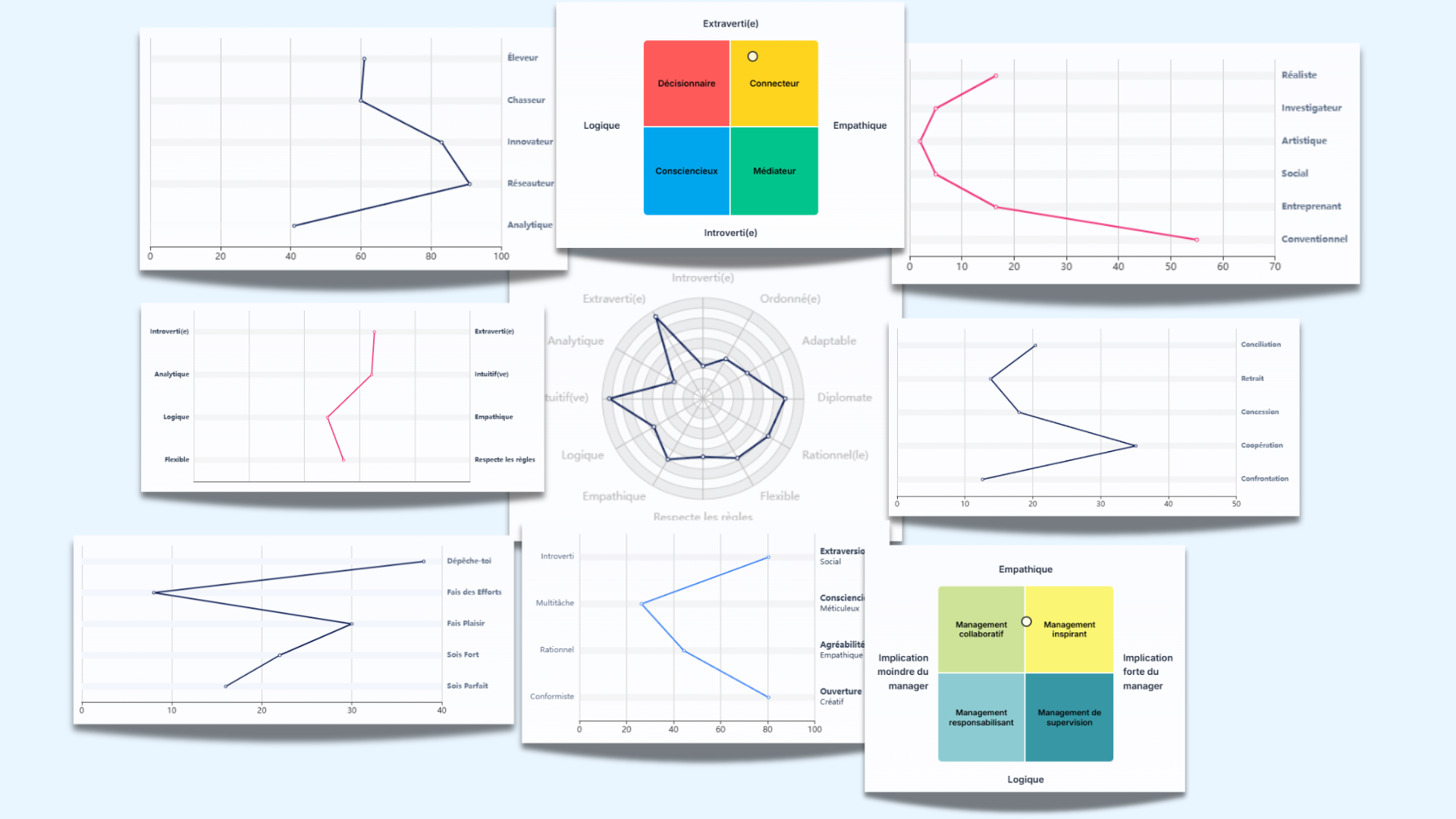
3) A short and structured candidate journey
The longest questionnaire is announced at 15 minutes, with an average observed time of 14 minutes. Two formats are available: a 3-minute format and a 15-minute format.
Reliability observed since Trimoji's creation:
- ✅ 85% on the advertised 15-minute questionnaire.
- ✅ 74% on the advertised 3-minute questionnaire.
4) Analysis of the candidate's journey during the assessment
Trimoji also analyzes the journey taken by the candidate during the assessment, with objectives such as:
- Profile certification.
- Analysis of potential biases in the journey analysis.
If the candidate's feedback is low, with a threshold of 67%, the candidate can choose a profile they identify with.
5) Actionable deliverables in a complete process
Personality analysis is part of a set of deliverables usable from the beginning to the end of a process, for example: Personi, analyses, interview outlines, comparisons, matching, onboarding, and then a candidate file that centralizes all useful information about the profile.
Practical Application
How to use personality analysis concretely?
Step 1: Define the objective
Define what you want to clarify: selection, coaching, integration, mobility, or collaboration.
Step 2: Administer the assessment
The candidate completes the questionnaire in the chosen format.
Step 3: Interpret and prepare for the discussion
Use the results to generate concrete discussion points, not an automatic conclusion.
Step 4: Decide or support
In recruitment, you secure a shortlist. In coaching, you build a realistic action plan. In onboarding, you prepare the conditions for success.
Concrete Examples
Typical Use Cases
Recruitment
Understand collaboration style, attitude, and points to watch for to prepare for the final interview.
Coaching and skills assessment
Put words to how someone works, clarify work preferences, and structure a progression plan.
Schools and students
Help to better understand oneself, position oneself, and prepare for entering the workforce.
Management and team
Better understand individual differences to adjust communication, role distribution, and team rituals.
Frequently Asked Questions
FAQ
Does personality analysis replace the interview?
No. It helps to prepare and structure the discussion. The decision remains human and contextualized.
Does Trimoji "put a label" on people?
No. The results serve as benchmarks for discussion, not as a definitive judgment.
Which format to choose between 3 minutes and 15 minutes?
The advertised 15-minute format offers higher observed reliability (85%). The advertised 3-minute format allows for quicker assessment with observed reliability at 74%. The choice depends on the context and the level of stakes.
What happens if the candidate's feedback is low?
Below the 67% threshold, the candidate can choose a profile they identify with.
Do you want to analyze personality in a structured and actionable way, without losing the human factor?