
Internal mobility aims to develop employees towards a new position, a new team, or a new scope, by limiting orientation errors and securing integration. Trimoji helps structure decision-making with more readable benchmarks on profile, potential, and team dynamics.
Internal mobility remains a matter of context, motivation, and opportunity. The platform serves as a support to objectify part of the information, prepare discussions, and build a support plan.
Would you like to secure your internal mobility with more readable benchmarks and a concrete integration plan?
Request a Trimoji demoWhy Trimoji?
When is Trimoji useful for internal mobility?
- ⏩ Transitioning to a new role without direct experience in the target field.
- ⏩ Bridging between teams or functions.
- ⏩ Reorganization, growth, creation of new departments.
- ⏩ Need to clarify the fit between an employee, a position, and a team.
- ⏩ Decisions involving multiple stakeholders (HR, current manager, future manager).
Our Approach
What Trimoji brings to internal mobility
1) Defining target roles with job briefs
With Personi, you formalize the requirements and priorities of the target role. This serves as a common reference to align HR and managers on expectations before evaluating internal profiles.
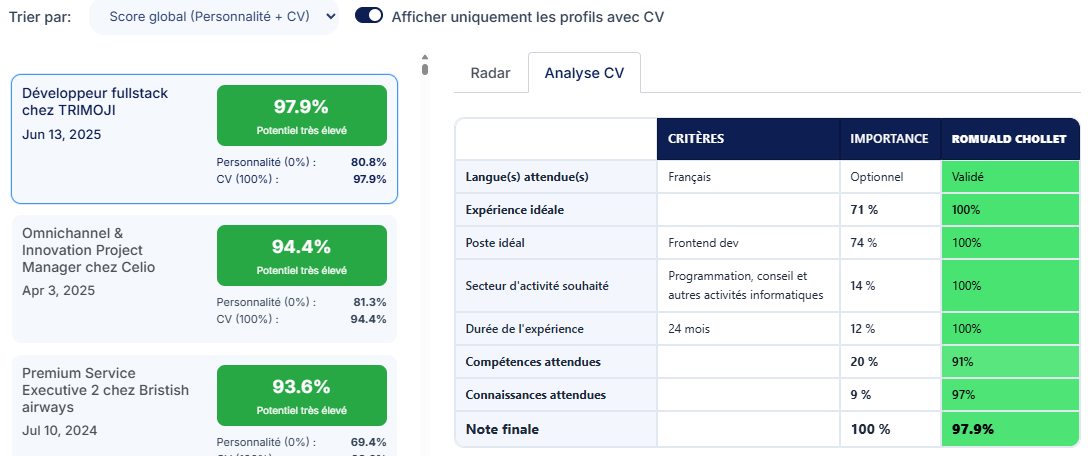
2) Better understanding skills, transferable knowledge, and soft skills
The analysis of soft skills and CVs provides insights into work styles, useful for projecting an employee into a new context, preparing internal interviews, and identifying success factors.
3) Discovering potential
This feature allows you to look beyond the current experience and identify success drivers, points of attention, and areas for development.
4) Structuring comparison between multiple internal profiles
When multiple employees are candidates, the profile comparator allows for a homogeneous comparison, making arbitration more transparent.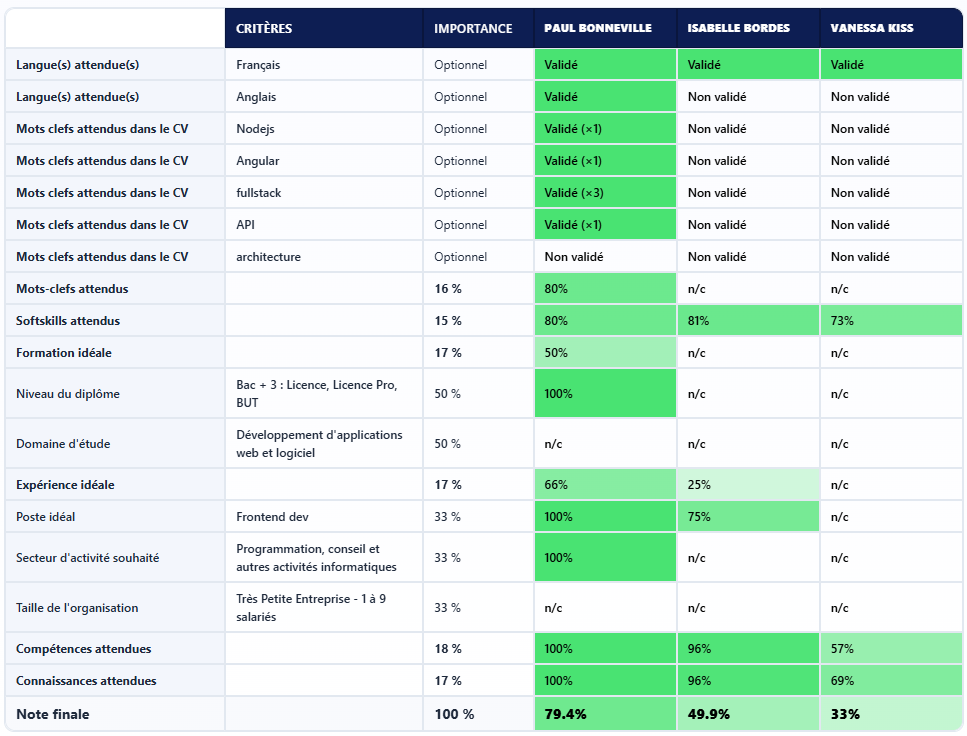
5) Adding a team perspective
In internal mobility, success often depends on the team. Team-oriented views and deliverables help understand team dynamics and relational compatibility, to anticipate integration and reduce friction.

6) Transforming the decision into an integration plan
Onboarding deliverables help secure the first weeks in the new role, with concrete guidelines for the manager and the employee.
7) Centralizing information in the candidate file
The candidate file consolidates relevant information about a profile in the context of a role, facilitating sharing, decision-making, and file traceability.
Methodology
Recommended process for internal mobility
Step 1: Clarify the target role
Create the Personi for the role or mission, outlining key expectations and context.
Step 2: Gather internal profiles
Identify candidate or potential employees, then prepare to collect necessary information.
Step 3: Analyze soft skills and CV potential
Perform the analysis of soft and hard skills, then leverage the potential assessment to understand success factors.
Step 4: Compare options
Compare 2 or 3 internal profiles if necessary, to clarify relevant differences based on the need.
Step 5: Project into the team
Analyze team dynamics and relational compatibility when the mobility involves a team change or a new manager.
Step 6: Decide and support
Share deliverables with decision-makers, consolidate in the candidate file, then prepare for onboarding and support.
Scenarios
Examples of internal mobility situations
- ✅ Transition from individual contributor to manager.
- ✅ Scope change (e.g., support to sales, ops to product).
- ✅ Mobility to a team with a different culture.
- ✅ Support following reorganization.
- ✅ Internal career change with skill development.
Frequently asked questions
FAQ
Does Trimoji replace the mobility interview?
No. It helps structure the discussion and objectify certain benchmarks, but the decision remains human.
Is it useful even if the person doesn't have the target job's CV?
Yes, because internal mobility often relies on potential and success factors, not just on past experience.
When should team analysis be used?
When mobility involves a new team, a new manager, or a sensitive team context.
Is it useful after the decision has been made?
Yes. Deliverables can be used for onboarding and support during the initial weeks.
Would you like to secure your internal mobility with more readable benchmarks and a concrete integration plan?
Request a Trimoji demo