 trimoji
 Matching a profile with a position involves evaluating the fit between a candidate and a real need, beyond job titles and gut feelings. Trimoji helps structure this assessment by cross-referencing available profile information and putting it in perspective with a job brief, to make decisions more transparent and coherent.
Trimoji does not replace the recruiter or the manager. The matching process serves as a support to objectify benchmarks, prepare interviews, and secure decision-making, while keeping context and the human element at the center.
Would you like to match profiles to positions more clearly, prepare better interviews, and secure your decisions?
Request a Trimoji Demo
Context
When to use profile-position matching?
- ✅ Need for clear framing from the start of the recruitment process
- ✅ Numerous profiles with similar or difficult-to-compare CVs
- ✅ Atypical profiles with transferable skills
- ✅ Decision-making between 2 or 3 finalists
- ✅ Recruitment involving multiple decision-makers (HR, manager, management)
- ✅ Internal mobility towards a target role
The Trimoji solution
What Trimoji offers
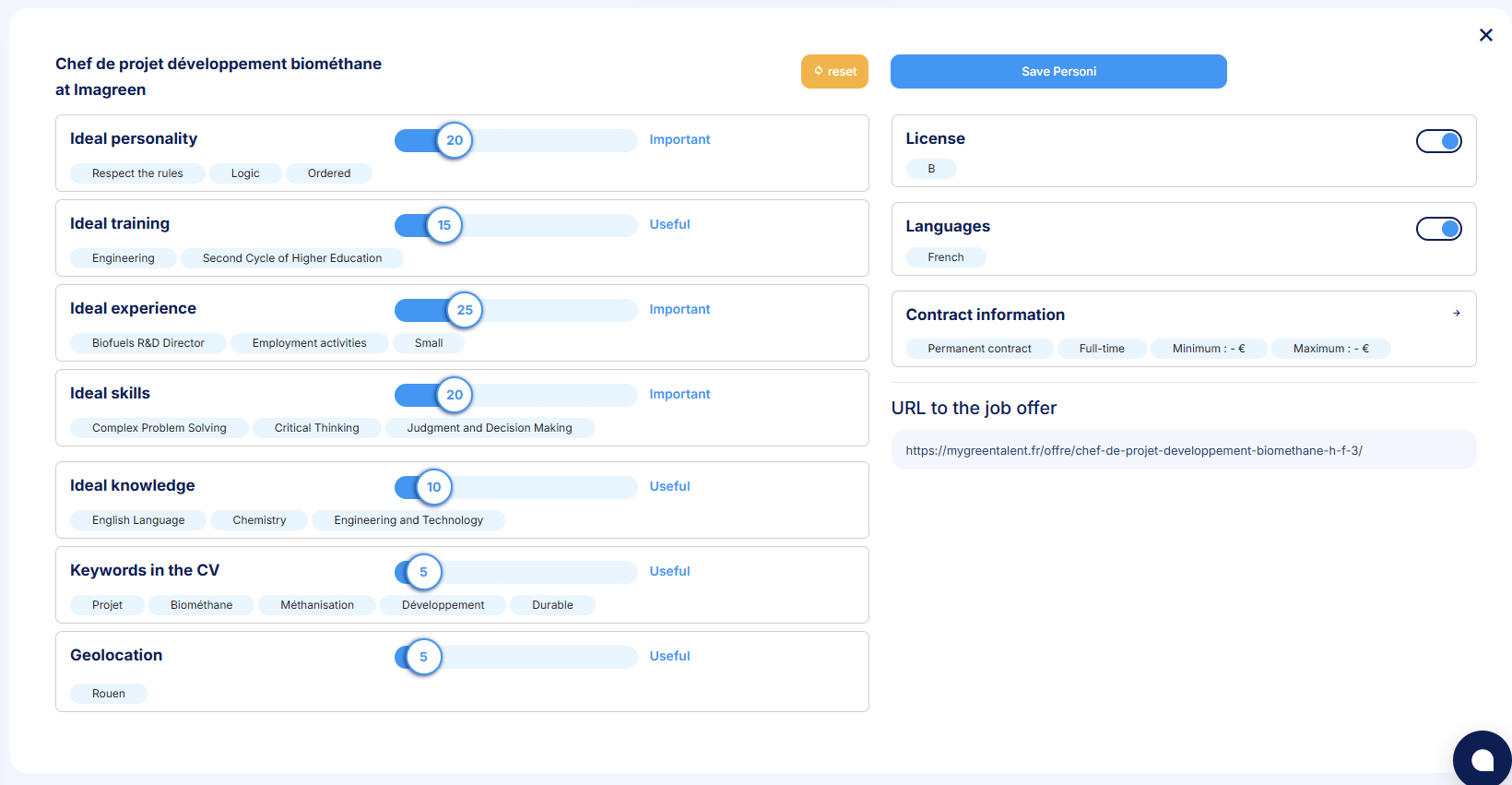
1) A clear job brief as a reference
With Personi, you formalize the ideal profile for the position with the expectations of managers and HR teams. This avoids vague briefs and serves as a common basis for comparing candidates.
2) Structured profile analysis
Trimoji helps structure candidate information, notably through:
- ⏩ CV analysis and scoring (consistent reading, transferable skills and knowledge)
- ⏩ Soft skills and personality assessment (work style, strengths, areas for development)
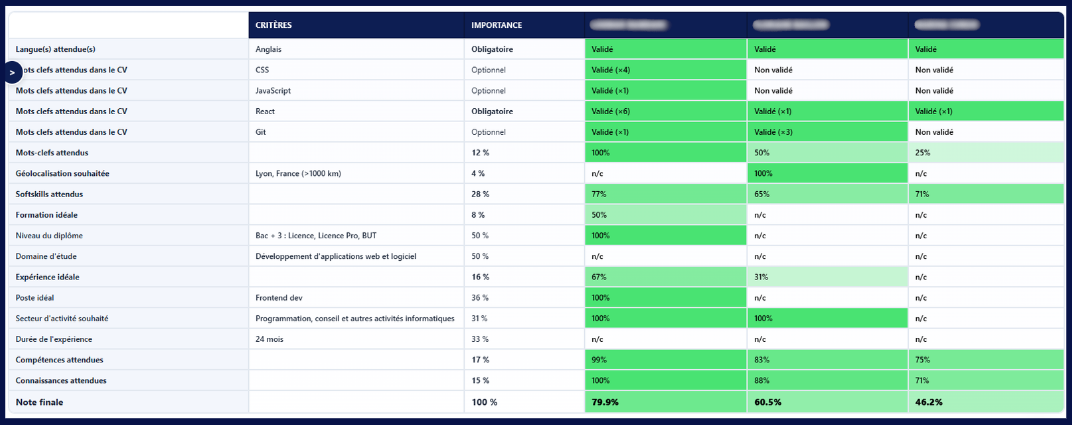
3) More transparent matching
The matching process connects a profile to the position, providing a concise and actionable analysis to prioritize a shortlist, align decision-makers, and clarify what fits and what's missing.
4) Deliverables for decision-making and action
The matching process is part of a comprehensive workflow, with reusable assets:
- 📄 Personi to frame the position
- 📄 Soft skills and CV analysis of the candidate
- 📄 Interview guide for verification
- 📄 Candidate and position scoring
- 📄 Candidate comparison if needed
- 📄 Candidate file to centralize all useful information on the profile and position
Methodology
Recommended process for matching profiles to positions
Step 1: Define the position
Create or validate the Personi with the manager. Prioritize truly important criteria.
Step 2: Collect and structure candidate data
Analyze the CV and, if relevant, administer the soft skills assessment to enrich the analysis.
Step 3: Read the matching report
Identify what matches, what's missing, and what's transferable or developable.
Step 4: Verify in interviews
Use the interview guide to challenge the matching hypotheses with concrete scenarios.
Step 5: Decide and centralize
Share the findings with decision-makers and consolidate them in the candidate file for a unified view of the profile against the position.
Concrete examples
Real-world use cases
High-volume recruitment
Prioritize applications faster with a stable basis for comparison.
Atypical profiles
Identify transferable skills that make a profile relevant, even if the CV isn't a perfect match.
Final shortlist
Compare 2 or 3 candidates and objectify the final decision.
Internal mobility
Project an employee into a target role and clarify the conditions for success.
Tips
Best practices
- 1️⃣ Define priority criteria before evaluating profiles
- 2️⃣ Use matching as a verification tool, not an automatic decision-maker
- 3️⃣ Supplement with interviews, references, and on-the-ground context
- 4️⃣ Keep a clear record with shareable deliverables
Frequently asked questions
FAQ
Does matching replace human decision-making?
No. It structures reference points and facilitates alignment, but the decision remains human and contextualized.
Is it useful if the candidate doesn't have the perfect CV?
Yes, especially for identifying transferable skills and clarifying what is developable.
When should matching be used?
After defining the position, from the pre-selection stage, then before in-depth interviews or the final decision.
What is the candidate file for in this context?
To centralize all useful information about a profile concerning a position, for sharing and decision-making with a unified view.
Would you like to match profiles to positions more clearly, prepare better interviews, and secure your decisions?
Request a Trimoji Demo