
Reducing churn means minimizing avoidable departures by recruiting profiles that are more aligned with the reality of the role, the department, and the company culture. The learning Personi is used to build a job brief based on real-world needs, drawing on the experience and characteristics of existing employees.
Trimoji does not replace the manager or the human element. Our goal is to provide a more objective framework to better define the desired profile, optimize candidate selection, and facilitate better integration within your teams.
Do you want to reduce churn by recruiting profiles that are more aligned with the real-world demands and your teams' culture?
Request a Trimoji demoUnderstanding
Why does churn often happen?
- ❌ Ideal profile defined on paper but not aligned with the daily reality of the role.
- ❌ Implicit criteria (culture, functioning, expectations) not formalized.
- ❌ Recruitment based on intuition or CV, without clear soft skill benchmarks.
- ❌ Poor team alignment, even if technical skills are proven.
The Solution
What the Learning Personi enables
The learning Personi allows for the definition of soft skill criteria based on the analysis of existing employees, in order to construct an ideal profile that is as close as possible to real-world conditions.
- 👥 Top performers in a department.
- 👥 Employees particularly aligned with the company culture.
- 👥 Teams that function very well within a given scope.
Method
Step-by-step process
Important note: It is necessary to administer the questionnaire to employees before creating a learning Personi.
Step 1: Create an internal campaign
You launch an assessment campaign dedicated to reference employees (those who embody success in the department or are particularly aligned with your company culture).
Step 2: Add tags for easy retrieval
You tag the campaign and participants to organize your database. Examples: "Top performers," "Culture fit," "Sales Team A," "Support N2." These tags allow you to quickly find the right profiles in Trimoji and build the learning Personi within a clear and defined scope.
Step 3: Analyze reference employees
Once the questionnaires are completed by the reference employees, their detailed analyses are available in Trimoji.
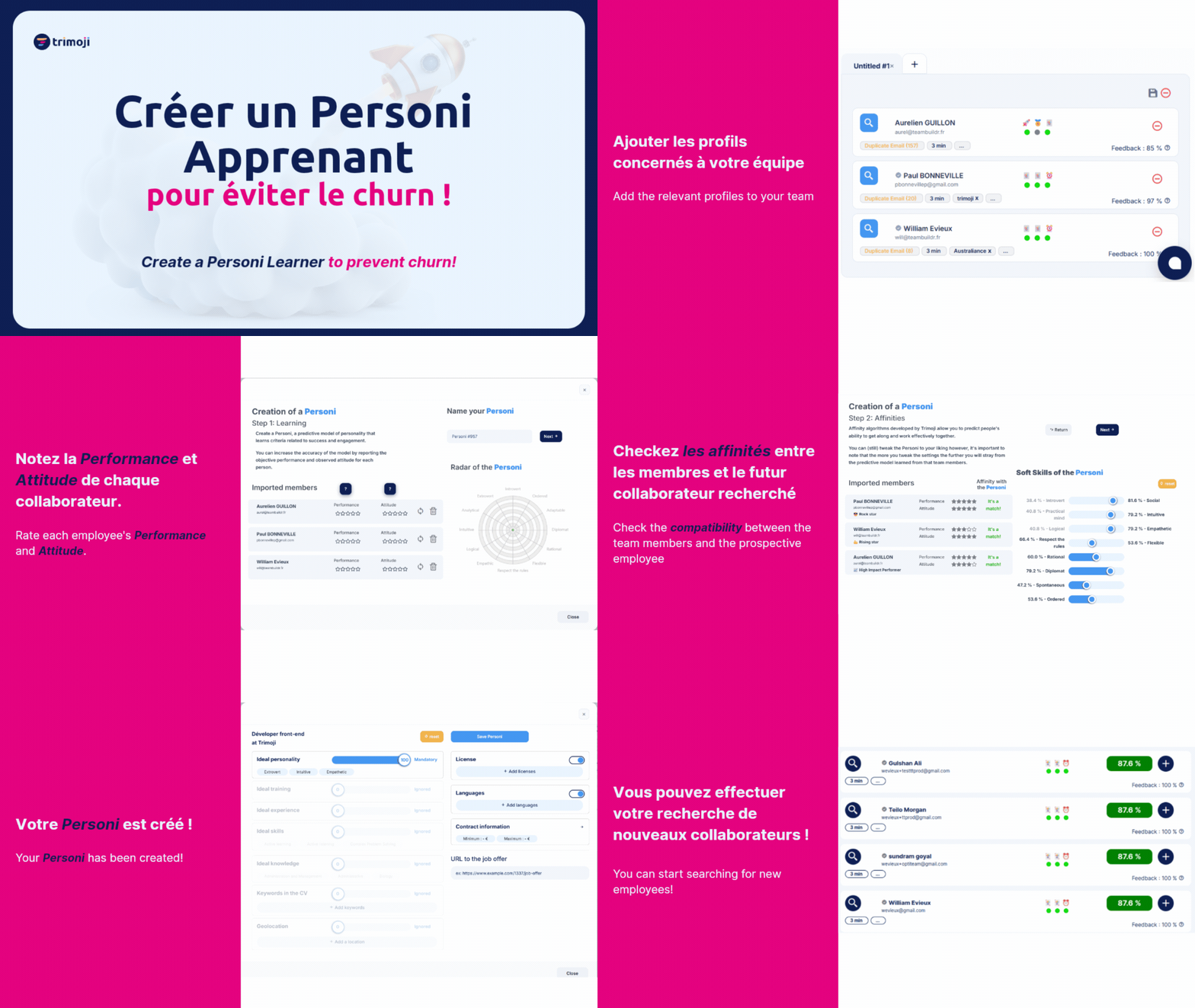
Step 4: Build the Learning Personi
You create the learning Personi based on the analyses of these reference employees. The Personi then reflects the soft skill criteria actually observed in the field, not just a theoretical job description.
Step 5: Recruit with a brief closer to reality
You use this Personi as a reference to evaluate candidates, secure selection, and limit recruitment that does not align with the actual context of the role and the team.
Step 6: Secure integration
You reuse the onboarding deliverables to prepare for the new employee's success and thus reduce the risk of early departure.
Applications
Use Cases
High-turnover departments
Building a Personi based on profiles that actually succeed, rather than a generic job description, helps stabilize teams.
Rapid growth
Recruiting quickly while maintaining operational and cultural consistency within the team is essential for healthy growth.
Teams with a strong culture
Formalizing the soft skill criteria that lead to success within the team helps avoid recruiting profiles that do not align with the existing culture.
Questions
FAQ
Why is a campaign necessary before creating a learning Personi?
Because it is essential to first analyze reference employees through the Trimoji questionnaire, in order to build a Personi based on concrete field data and not on assumptions.
What are tags for?
Tags are essential for easily finding reference employees and for maintaining a clear and organized scope when building the learning Personi (by department, team, population, performance level, or cultural criterion).
Does this guarantee zero churn?
No, absolute zero churn is an ideal that is difficult to achieve. However, this approach significantly reduces avoidable churn related to incompatibilities in culture, team, and functioning.
Do you want to reduce churn by recruiting profiles that are more aligned with the real-world demands and your teams' culture?
Request a Trimoji demo